Another Weekly Update

Hello everyone. It’s time again for the mid-week update. The daily film reviews are still going strong. I have today’s one ready to publish, between 5pm and 6pm (UK time). I also have tomorrow’s written up. Today will be Dario Argento’s Phenomena which I watched last weekend, tomorrow will be Monster, directed and written by Patty Jenkins.

This weekend, I’m also planning on reviews for Escape Room 2, The Forever Purge, Fear Street part 3 and Space Jam 2. The order isn’t completely set in stone, but keep an eye out because they will be coming.

On Friday morning, I’m also going to be uploading the second part of my top 50 films. I’m looking forward to sharing this with everyone. The post is written and ready to go, so that will be going up around 9am on Friday.

Next Thursday, the plan is to put up the next Franchise Catch-Up, which will be John Wick. I’m going to binge them over the weekend. I don’t know whether I’m looking forward to them or not, they’ve just never appealed, but I live in hope. Fingers crossed I’ll think I’m stupid for putting them off.

I’m also hoping to finish reading some books to do another book post next week some time. I don’t have a set date for this. Writing is still going steady, and the new short story should be ready either for the last week of July or the very start of August.

Something else I want to talk about briefly is getting back into shape. I used to have a more physical job where I was constantly on my feet and moving about. For a brief year or so I was a healthy weight for the only time in my adult life. Since moving to office work, and especially since working from home, I’ve put on a lot of weight and am in no way physically fit. I really need to do something about this, as it’s having a bad effect on my life and mental health. My knees are achy a lot of the time, which is a problem I used to have before losing weight previously. I don’t want to have long-term problems due to bad eating and exercise habits. To motivate myself into getting back into shape, I’m going to be posting my weight, and target weight each week. Having it out there will hopefully keep me moving in the right direction. I have a small trip planned in November for Wales Comic Con and that’s the deadline to get back into shape. I know I can do it, I just need to actually focus on it.

I hope there’s something above that sounds interesting and you’re looking forward to what’s up ahead.

Thanks for reading and until next time,

Ashley

Posted in Updates | Tagged , , , , , , , , | 2 Comments

Lucky – Film Review

Director: John Carroll Lynch

Starring: Harry Dean Stanton, David Lynch, Ron Livingston, Ed Begley Jr, Tom Skeritt and Barry Shabaka Henley

Rating: ★★★★½

Lucky is a very melancholic, sombre, and sweet look at old age and death. Lucky, played by Harry Dean Stanton (Twin Peaks, Alien and Cool Hand Luke) in his penultimate role, is a 90-year-old stuck in his routine. That’s how we are introduced into the film, slowly through one day in his life. It moves very slowly through each moment of the day, from his yoga exercises to his nightly visit to the local bar. It’s on the second day when the main theme of the film makes itself known. After having a fall, and the doctor’s only reasoning being that Lucky is old, he is forced to face his own mortality and existential dread. Early in the film the word ‘realism’ is given a dictionary definition while Lucky is playing a word game with his friend over the phone. It’s through this that the film tells us what it is about. It’s about accepting the inevitability of death, understanding it and dealing with it head on.

On top of this, the film deals with the ideas of alienation and belonging. Lucky doesn’t have any family and spends most of his time alone. He says there is a difference between being alone and being lonely, but that Venn diagram starts to feel like it overlaps more and more as the film carries on. In the first day, when Lucky is getting his coffee, there is a wide shot showing how out of sync Lucky is with the people around him as they move quicker than he does. It’s subtle, showing that the world has left him behind and he isn’t going to be catching up. The party sequence in the second half shows him feeling alienated from those around him. Instead of letting this define him and accepting that this isn’t for him to fit in with, he decides to join in and start a sing-a-long. It’s a really sweet moment of choosing to enjoy life.

Harry Dean Stanton, a long-time collaborator with co-star David Lynch (Director of Twin Peaks, Inland Empire and The Straight Story all which Stanton acted in), gives a showstopper performance as Lucky. It’s powerful, captivating, and compelling. He is the emotional weight of the film, and it wouldn’t work without such a stunning performance. It would be so easy for this film to become boring. We are essentially following around a 90-year-old as he goes about his day-to-day life. It’s Stanton’s performance that brings out the best parts of the small moments and connects with the audience in an emotional way.

Next to Lucky is Howard, played by Lynch. A man who has one love in life, his pet tortoise President Roosevelt. He has escaped and Howard spends most of the film wishing he would come back, while at the same time praising Roosevelt for his daring escape. The tortoise is a hundred years old and as the pet shop owner explains, can live a hundred more. It’s reflective of the world around Lucky, it’s been here before him and will remain after him, but Howard doesn’t see this as something negative. He spends time writing a will out to ensure that Roosevelt is looked after in the future. Lucky on the other hand is more downbeat, taking a more nihilistic approach, not setting the time on his coffee maker showing that he doesn’t see the point of doing something now that will benefit the future. The whole cast is great and the moments in the bar with the whole group are fantastic and the stand out scenes.

Lucky is an amazing film. It’s very slow and sombre and gives its themes time to breath. Director, John Carroll Lynch (Not related to David Lynch, but did play Twisty the Clown in American Horror Story) brings to life a story that could have so easily fallen apart. As director, he brings out great performances from everyone. It may not bring tears to your eyes, but it is still emotional and a captivating exploration of the end of a life. Stanton’s performance is exceptional and this is something that is both thought provoking and life-affirming. 

Posted in film reviews | Tagged , , , , , , , , , , | Leave a comment

My Upcoming Watch List

Tabby and I moved into our own house in August 2017. Since then I’ve always been borrowing DVDs from my mum. Whenever I give a couple back, I take a couple more and I’ve haven’t ever been without at least something from her shelf, normally something with Nicolas Cage in it. That’s my aim for this week, to get that pile down to zero. I have 3 remaining. Leaving Las Vegas (The Cage film in the list), The Hours and 13: Game of Death. I’m sure I will then borrow more when I give these back.

I’ve also promised a colleague to watch Miracle in Cell no. 7. He told me to watch it, close to a year ago now, and I keep on meaning to. I plan to watch that this weekend. I’ve also been recommended Let the Right One In, by one of my oldest friends and plan to get around to that this week as well.

I mainly watch films through a DVD rental service we have in the UK, Cinema Paradiso. While there are a lot of films on Netflix, Disney Plus and Amazon. The streaming giants don’t offer everything and when I find something I want to watch, I want to watch it as soon as possible. I have 2 discs on the way, which should arrive tomorrow. April Fool’s Day and The Suicide Club.

April Fool’s Day is on the list, as I’ve been watching In Search of Darkness, an extremely long documentary about 1980s horror. Anything that’s taken my fancy has gone on the list and April Fool’s Day is the next to arrive.

The Suicide Club was on the list, as I’ve recently read a few blogs and seen a couple of YouTube videos about the films of Japanese director Sion Sono. I haven’t seen much Japanese cinema, mostly the classic horror films, and liked the style of Sono from what I’ve seen. I added a lot of his films to my list and will hopefully be watching a ton of them soon. (Funnily enough he’s also directed Prisoners of the Ghostland which stars Nicolas Cage and is due to get its premier in London in August. Everything is connected).

There are also a few cinema releases due out this week that I plan on seeing. The Forever Purge, Escape Room 2, The Croods 2 (Also Cage) and Space Jam 2. Lots of sequels this week. I have a Cineworld Unlimited card and try to see everything I can. There’s another film out this week called Deerskin, which looks good but would mean travelling a fair distance to see it as it’s not being shown at my local Cineworld.

I just thought I would post a quick list of what I was planning on watching soon, with reviews for most of them shortly afterwards. Have you seen any of the films I’ve mentioned, or want to? Let me know.

Thanks for reading and until next time,

Ashley
Posted in film reviews | Tagged , , , , , , , , , , | 3 Comments

Fear Clinic – Film Review

Director: Robert Green Hall

Starring: Robert Englund, Thomas Dekker, Kevin Gage, Fiona Dourif, Brandon Beemer and Corey Taylor

Rating: ★★

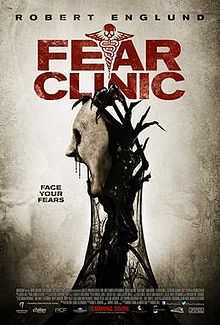
There are so many horror films released each year that it’s impossible to keep up with them all. A lot slip by, even if you have the intention of watching it. When looking back at those you’ve missed there has to be a reason to grab your attention and Fear Clinic’s hook is that it’s Corey Taylor’s (Slipknot and Stone Sour singer) first acting role, alongside horror legend Robert Englund (Nightmare on Elm Street). Sadly, Fear Clinic isn’t worth checking in to.

Robert Green Hall adapts the web-series of the same name, that he also directed back in 2009, expanding it into a feature length film. The idea is that fear can be conquered. Englund plays Dr Andover who has designed a chamber that can help people get over their fears, using a mix of hallucinations and sensory deprivation. While his patients are in the chamber, Dr Andover wears a strange mask that includes a monocle to speak to the patients while they are under. It looks cool and steam-punky, but does make you wonder why it’s designed that way other than aesthetics. Through the treatments there is an evil entity that is breaking through to our world and with each one it gets closer to opening the door. This is told through a hallucination that Andover has when he touched the ‘fear residue’ that his patients are throwing up.

The effects on this are a real mixed bag. The practical effects look amazing, a real throw-back to horror films like Carpenter’s The Thing or Cronenberg’s The Fly.  Sadly, this is mixed with some of the worst CGI from the last decade. The cockroach from the opening sequence looks so bad, that it makes you want to turn the film off at the beginning and then there is some spiders later on that look equally rubbish. They just shouldn’t have been there. The practical effects are so good that when you see the low quality CGI, it looks horrendous.

The pacing is also a mess. It takes quite a while to get going, and then it just rushes through the later half of the film. It genuinely feels like there are missing parts. It’s not cohesive enough to create any true fear or terror. Instead, it just becomes boring. It’s not hard to follow the plot, but it’s not engaging in any way that makes you want to care. The twist makes no sense. Without spoiling it too much, the main group of patients are all connected by a shooting at a restaurant. The twist, being that one of them is the shooter. How did the police not pick them up? It’s hard to go into why it’s so stupid without spoiling it, so I’ll stop there just in case you feel the need to watch it. But when you do, don’t think about it too much or it will just unravel.

Fear Clinic is not scary, it’s only barely watchable. The only reason to watch this is Corey Taylor, who is pretty brilliant and Robert Englund . The rest of the cast aren’t even that convincing. It’s a good idea, with some great practical effects, but it’s presented in an unengaging way. After watching it you’ll have to check into Boredom Clinic to recover.  

Posted in film reviews | Tagged , , , , , , , , , , | Leave a comment

Tokyo Drifter

Director: Seijun Suzuki

Starring: Tetsuya Watari, Chieko Matsubara, Hideaki Nitani, Tamio Kawaji and Tuyoshi Yoshida

Rating: 3.5/5

Seijun Suzuki directed around 40 films in a little over a decade from 1956 to 1967, for one company, Nikkatsu. Most of these were B movies from the Yakuza genre, Japanese mobster/crime films. What made Suzuki’s films from that era unique, especially the later ones, is that he put his own style into the films. To the point that the studio tried to tone that down and after Branded with Love was released in 1967 he would be fired and blacklisted from the business, before returning as an independent film maker in the late 1970s. Outside of Japan, he started to receive recognition in the 80s and 90s and was an inspiration for directors such as Quinten Tarantino and Jim Jarmusch.

Suzuki’s style was seen as psychedelic and out there for the studio that hired him. While he didn’t intend it himself, he took pride in people claiming that his films were surreal. In reality he just wanted the film to look nice and be a little different. Most of his films, including Tokyo Drifter, were made in a very short time span with a very strict budget. Films were given 28 days to be completed in, 25 days for shooting and 3 for post-production.

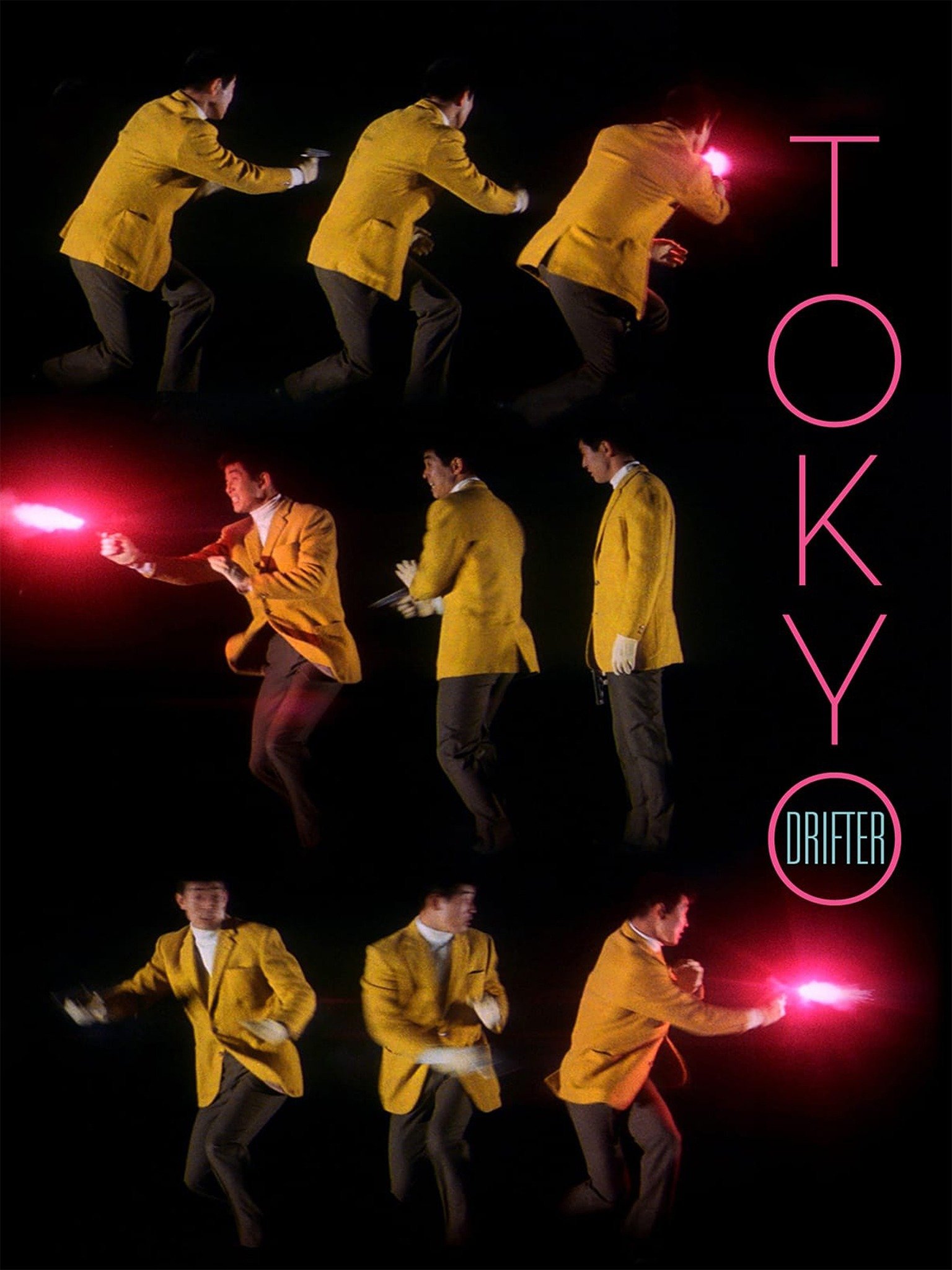
It was the low budget that the striking images from his films came from. The final shoot out in Tokyo Drifter takes place in an almost completely white bar. Everything is minimalist and stylised to make it pop on screen. Even the clothes of the actors blend in and create a distinct visual flair to everything. Every scene in Tokyo Drifter has a distinct and intense colour scheme to it and this was after the studio had decreased his budget to stop this. His next two films were shot in black and white with an even more limited budget.

Tokyo Drifter feels like a strange film when you watch it. It’s a Yakuza film, with the usual violence and death, but there is a light heartedness to it. The drifter is Tetsu the Phoenix (Watari), a former yakuza whose family is disbanded when their patriarch tries to run a legitimate business. It doesn’t go exactly to plan and with rival clans after Tetsu, he ends up on the run moving from Tokyo to Kyushu, an island in southern Japan.

While a lot of Yakuza films from that period romanticised the Yakuza as an almost successor to the samurai, with their focus on loyalty and honour, Tokyo Drifter departs from that showing that most of the Yakuza don’t have loyalty to their long-time friends. Tetsu is betrayed at every turn by almost everyone he thinks he can trust. Emphasising the departure from the old style, known as ‘ninkyo eiga’ (chivalry films), Tokyo Drifter starts in black and white with a scene where Tetsu is punished for the loyalty to his clan’s leader. He is brutally beaten by a rival clan trying to bring him to his breaking point and fight back. There are Yakuza watching, hoping for this to happen and they imagine the breaking point with flashes of colour.

Afterwards Tetsu is left wounded without breaking, he gets up and finds a broken toy gun, a striking red compared to the black and white opening. We are then shown Tokyo streets in full glory, with short, almost frantic snippets of neon signs and buildings. Followed by a sequence with a modern western-inspired bar with the dancing youth, shot from underneath as Suzuki wanted the scenes to be interesting to watch and not a bland dance sequence. The story goes from traditionalist in black and white, to striking and different in full colour.

The film is also filled with absurdist humour. Tetsu has his own theme song, which he sings repeatedly throughout. The film was designed to make this song a hit by the studio, and Suzuki uses this to bring out a quirky and unique feel. There’s also one point where Tetsu is escaping a group that have chased him through a snowy wooded area and he trips over an outstretched leg. We can see the leg sticking out as the audience, but Tetsu somehow doesn’t, even though the man is standing behind the tree in clear sight of Tetsu but hidden from us. And the absurdist humour goes even further with one of the final sequences, the saloon fight, that’s almost a parody of the western films from Hollywood that Suzuki loved. The whole scene is a blast and downright funny.

The biggest downfall of Tokyo Drifter is how short it is. It’s barely 80 minutes, due to the strict and constrained budget and b movie nature. The story could do with some more time to breath to really grip you. It’s fun while it lasts, but it does still feel like a b movie in places and isn’t spectacular. Despite this it is still a classic of Japanese cinema. It races along, never missing a beat with humour, violence, and music. While this film could blend into the sea of movies from this period, it uses its limitations to bring something colourful and vivid to life. 

Posted in film reviews | Tagged , , , , , , , , , , | Leave a comment