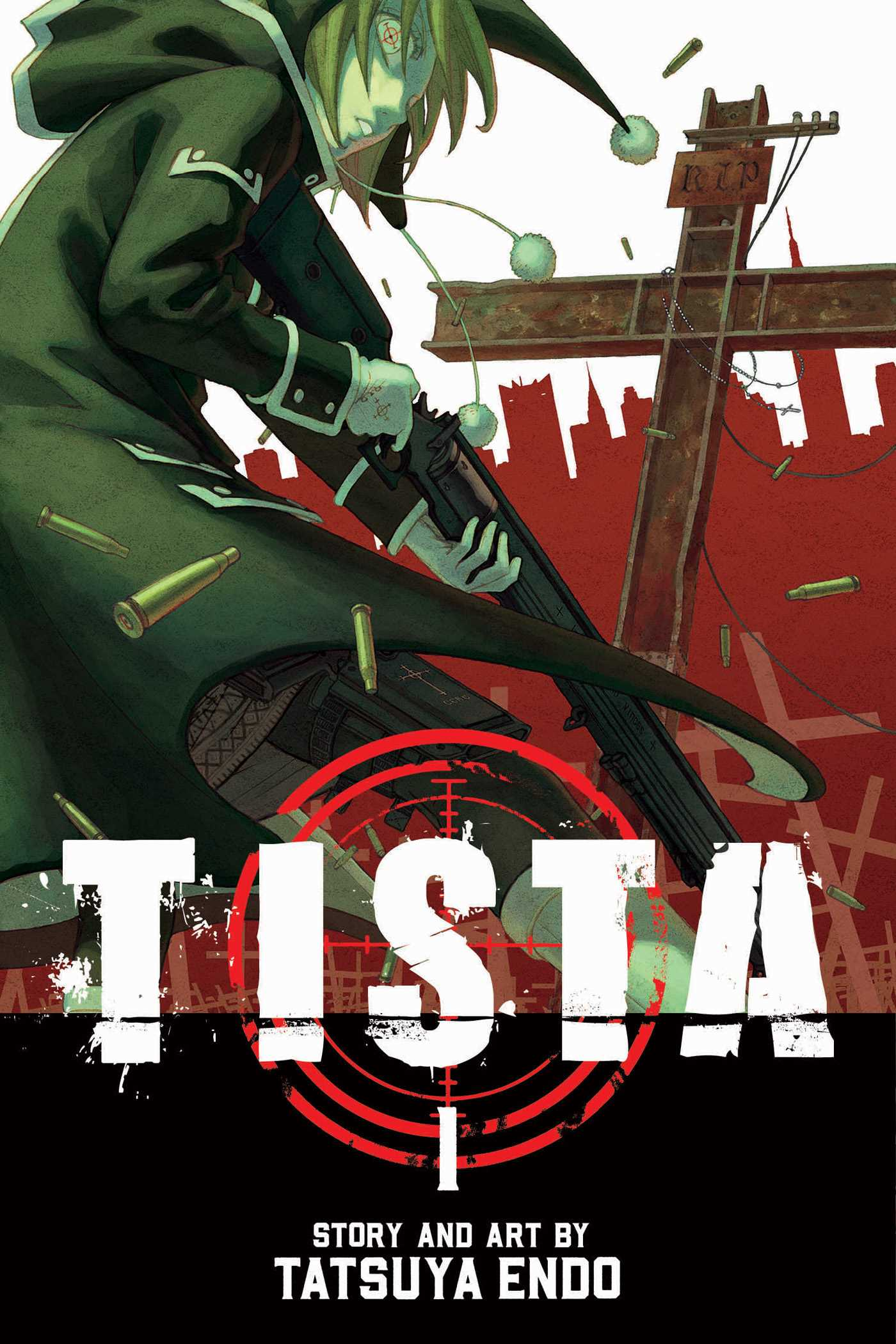
Over ten years before Tatsuya Endo created Spy x Family, his first serialised manga was Tista, and the first volume has now been published in English. It’s set in New York City, where an assassin known as Sister Militia, has been evading the police for years. Her skill is extraordinary, taking shots from extremely far distances, and her targets seem to be bad people. The police have no idea that her real name is Tista Rockwell, and when she’s not assassinating people for a church, she’s going to school in the hopes to one day become a teacher.
The main reason I picked this book up was because it was by Endo, and I love Spy x Family. I’m sure many others will pick it up for the same reason. This is a very different story. It’s a lot darker tonally and there’s not as much humour. Still it’s a very good first volume that had me hooked pretty quickly. The first chapter takes a little while to get going, but by chapter two I was invested and wanted to know what happened next. After making a new friend, who just so happens to be connected to her next target, Tista ends up questioning her own life and what’s going on around her.
As the first volume unfolds the story keeps quite a slow pace. The art is fantastic, but for a lot of the volume there’s not much happening. The series only ran for two volumes, with the second one due out in July in English, and with how slow paced the first volume is, it seems hard to believe the story will be completely wrapped up in the second volume. I’ll be cautiously excited to read it when it comes out.
Starring: Robert Mitchum, Shelley Winters, Lillian Gish, Billy Chapin, Peter Graves
Rating: ★★★★
The Night of the Hunter is a crime thriller from 1955, that’s directed by Charles Laughton and written by James Agee. It’s based on the 1953 novel of the same name by Davis Grubb. When the film was first released it was a massive flop with both critics and audiences, to the point that Laughton never directed a film again. Over the years it’s been reappraised and is now considered to be one of the greatest American films ever made, influencing countless filmmakers in the decades since.
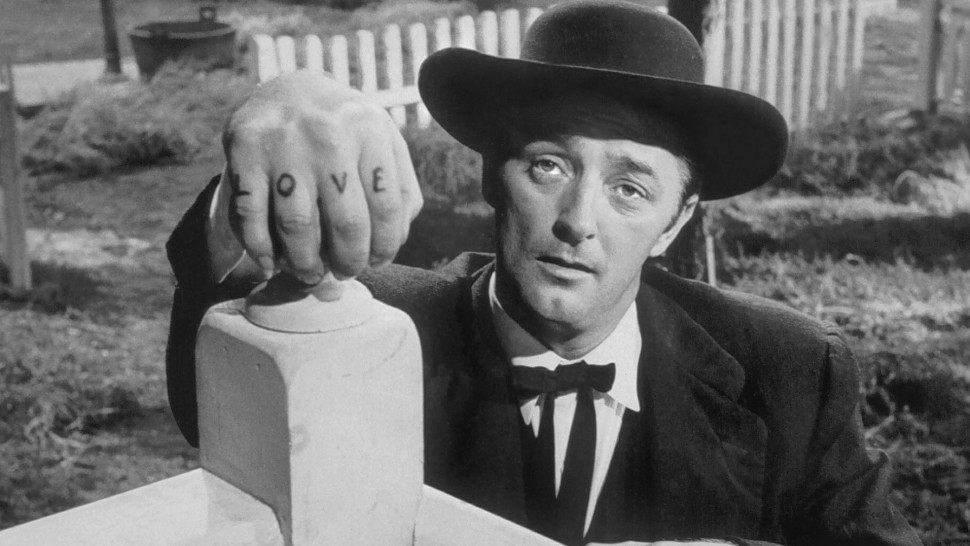
It follows Harry Powell (Robert Mitchum), a con man pretending to be a reverend. While he’s in prison for driving a stolen car, he’s cellmates with Ben Harper (Peter Graves) who had murdered two people and stolen around ten thousand dollars in cash that hasn’t been recovered. Harper takes his secret to the grave with only his two children, John (Billy Chapin) and Pearl (Sally Jane Bruce) knowing where the money is, and to find it Powell worms his way into their mother, Willa’s (Shelley Winters) life pretending to be a reverend who knew her late-husband while he was in prison. He marries her and tries to find the location of the money from the children, while masquerading as a stand-up citizen to everyone else in town.
Robert Mitchum is absolutely fantastic as Harry Powell. He’s instantly charming and lovable and at the same time completely terrifying. In one of the opening scenes you see him watching a dancer on stage, while playing with a knife in his coat pocket, and it tells you everything you need to know about the character. As soon as he finds his way into Willa’s life you know this isn’t going to end well for her. He’s incredibly sinister, but at the same time it’s easy to see why everyone is won over by him. At one point, Willa is practically brainwashed into believing that he’s there to save her family. The only one who sees straight thought his act is John, who knows that he’s just after the money, but as a child no one will listen or care so he just has to protect his sister at all costs.
Visually, this film is an absolute masterpiece. It’s stunning to watch. You can feel the influence from silent German expressionist films almost straight away. Foreboding shadows, angular buildings, and a dreamlike feel to some of the sets, where neon signs aren’t connected to buildings, and Willa’s bed seems to be a step removed away from the rest of the set, pulled forward and reflecting how fragmented she is. On one hand she’s still mourning the loss of her husband, which she at one point blames herself for, and on the other she’s trying to give her children the best life possible. The way that Harry treats her is full-on mental abuse, and she can’t even see it.
One of the best parts of the film, and again visually brilliant, is where John and Pearl are escaping from Harry on a little rowboat down the river. The nail-biting tension is at complete odds with the calm and naturalistic setting. The camera focuses on frogs, and rabbits on the riverbank as they sail on past. Rabbits reappear later in the film, as they’re hunted by an owl, reflecting how close Harry is at that point to getting what he wants.
For a film that’s heading towards seventy years old, it doesn’t feel dated at all. The visuals are stylish, the performances are brilliant, and the story is timeless. Supposedly there’s a remake on the way, but there’s no way it can hold a candle to the original.
Thanks for reading! If you liked my review, please subscribe to never miss a post:
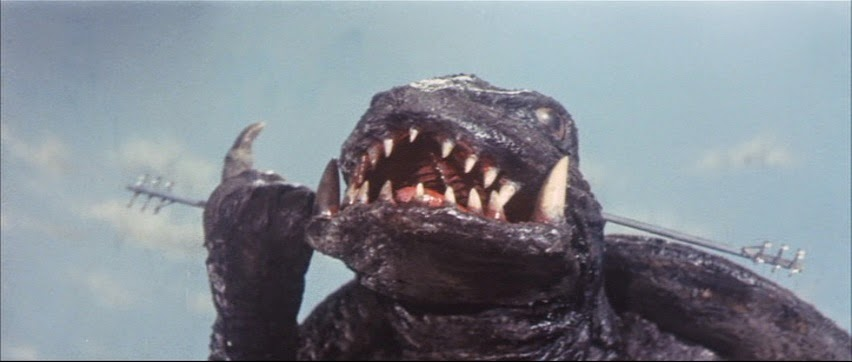
For his sixth outing Gamera is fighting Jiger, a massive reptilian kaiju that may be the toughest enemy Gamera has fought so far. The film is almost an advert for Expo ’70, which was being held in Osaka in 1970 and started shortly before the film was released. The opening scenes of the film show Japan preparing for the Expo and giving hints at what would be there. It was also agreed that the buildings in the expo wouldn’t be destroyed by Gamer and Jiger’s fight.
What kickstarts the big battle is the removal of a statue from Wester Island, known as the Devil’s Whistle. Despite warnings from the indigenous people of the island and Gamera trying his best to stop it, the statue is removed to be taken to the expo. The statue, which is supposedly cursed, makes almost everyone who deals with it ill. More shockingly, it unleashes Jiger who had been kept buried by the statue for centuries. Later on, it’s revealed that the statue has a small hole that runs through the whole thing, and had been filled with blood at one point. When wind travels through the statue, it creates a high-pitched noise that’s similar to white noise and that’s what kept Jiger incapacitated for all those years.
The first fight is pretty epic, where Gamera looks like he’s going to win for the longest time, before Jiger turns it around shooting spears made out of solid saliva into Gamera’s limbs and leaving him turned upside down and unable to move. For a kids film, it’s pretty distressing to watch. When Gamera does eventually free himself and chase down Jiger, he doesn’t have the upperhand once again, and ends up being injected by Jiger, and almost like a virus is completely frozen while Jiger’s baby is growing inside of him – again quite dark for a kids film.
This is where the goofy nature of the Gamera films really comes into full force. Two children, who have been rooting for Gamera the entire time, jump into a micro-sub and travel inside Gamera to try and save him. It just so happened that Gamera froze with his head underwater, to allow the sub to travel inside, and somehow not drown at the same time. It’s the best kind of dumb. Gamera’s insides are surprisingly quite a lot like a cave, and the two children travel through quite easily before finding the baby Jiger.
The fights throughout the film are entertaining enough, also a bit clumsy with the cumbersome suits the actors were wearing. It’s very much like a wrestling match, which is what the creators of the film used for reference to keep the fights feeling fresh and entertaining. The film also has a higher budget than some of the other recent entries, so there’s not as much reliance on flashbacks or re-using footage. New sets were built for the film and it boasts a large cast of humans to watch and help Gamera in his fight.
Goofy fun is a good way to describe this entry to the Gamera series. It’s not brilliant, but it’s fun while it’s on and there’s worse ways to spend eighty minutes.
Thanks for reading! Don’t forget to subscribe to never miss a post:
Starring: Jordana Brewster, Clea DuVall, Laura Harris, Josh Hartnett, Shawn Hatosy, Famke Janssen, Piper Laurie, Bebe Neuwirth, Robert Patrick, Usher Raymond, Salma Hayek, Jon Stewart, and Elijah Wood
Rating: ★★★½
The Faculty is a 1998 horror film directed by Robert Rodriguez and written by Kevin Williamson (who also wrote Scream). It’s reminiscent of classic sci-fi horror stories, such as Invasion of the Body Snatchers and The Thing. When the film first came out it received mixed reviews, and in the years since has gained a well-deserved cult following.
The teachers at Herrington High School are slowly being infected by an alien race, that are replacing them in their day to day lives. A group of students start to notice that the teachers aren’t acting normally and are also starting to infect the students. Casey (Elijah Wood) has to team up with other students that he wouldn’t usually hang out with to try and save the school.
It starts with a really tense scene with Principal Drake (Bebe Neuwirth) of Herrington High School being chased through the school by Coach Willis (Robert Patrick) who’s already been infected by this point. In true Terminator 2 style Willis is relentless and no matter what Drake does to try and get away she can’t. It’s a great opening, that’s the closest the film comes to being truly scary.
After that the film takes a much more teen horror tone. We’re introduced to the main characters, all with their names coming up on screen for you to forget moments later, as they go about their day to day life, and things start to get a little unusual. The school is incredibly run down and looks like it’s ready to fall apart in most scenes. Most of the budget for the school goes to the football team, while everything else is left underfunded or cancelled. You really get the impression that this is in the middle of nowhere, so it makes sense that this is the place where an alien invasion would start.
The characters are really well written. On the surface they appear as if they’re just stereotypes, but there’s more to them than that. They’re all suffering in some way or another from the assumptions people make about them. There are also some really great performances from the cast, a lot better than you’d expect from a high-school horror from the 90s. It does a good job at capturing the anxiety of being on the cusp of adulthood. The star quarterback, Stan (Shawn Hatosy) doesn’t like how people treat him better just because he’s good at sports, while he struggles with the academic life. He wants to quit sports to focus on other things.
As you’d expect most of the story is the main group of students trying to avoid being infected while also trying to find a way to stop the invasion. There are some tense moments as they’re being chased around. You care about the characters, and want them to survive, so even though it’s all been done before, it still works. Towards the end there’s a nice twist, that makes complete sense, and is also completely shocking when it happens. The effects are a little dated, especially the CGI, which considering this is twenty-five years old isn’t surprising. None of that is that distracting though, and just adds to the charm of the film.
While it’s not as referential as the original Scream, The Faculty does play with the tropes and ideas of sci-fi. It subverts expectations and does have a few moments where the characters discuss the genre to help them decide what to do next. There’s also a scene where they are testing each other to see if they are infected or not, that’s pretty much the same as a scene from John Carpenter’s The Thing, and just as tense. It also doesn’t feel like it’s just lazily ripping off what’s come before, which is mostly due to the characters and performances.
The Faculty is a bit of a hidden gem film from the late 90s. If you’re a fan of things like The Craft, Scream, or Buffy, and you haven’t seen this then it’s really worth checking out.
Thanks for reading! If you liked my review, please subscribe to never miss a post:
Starring: Taron Egerton, Toby Jones, Nikita Yefremov, Roger Allam, Anthony Boyle
Rating: ★★★½
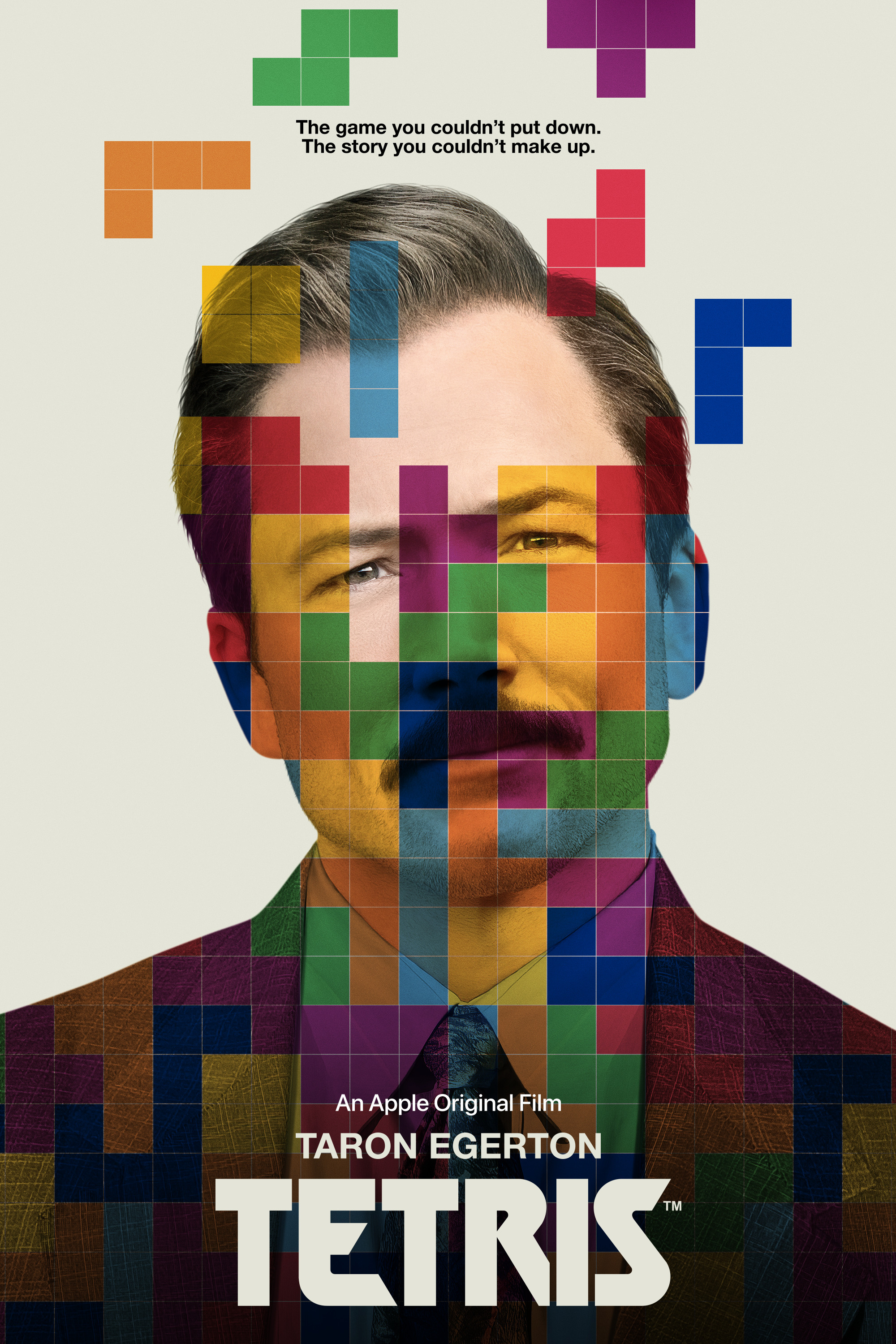
You wouldn’t expect a film about the origins of the video game Tetris to be a Cold War thriller, but that’s exactly what Tetris is. Taron Egerton stars as Henk Rogers, the founder of Bullet-Proof software who brought Tetris to the world, in a story where there are surprising similarities with the 2020 film The Courier starring Benedict Cumberbatch.
Taron Egerton is absolutely brilliant in the leading role, as he is in everything film he’s in. He’s completely believable as Rogers, being charming and likable straight away. He’s so good in the role that you forget everything else you’ve seen him in and are completely invested in his story. It’s easy to believe that he would be able to travel to the Soviet Union and while avoiding the dangers of the KGB, manage to broker a deal to get the rights to Tetris for Nintendo.
Even though it’s about a video game, this is a thriller through and through. Some of the tensest scenes are when Henk is travelling through Moscow, the KGB always following him, taking photos and trying to intimidate him to leave the country. There’s a great sequence where Rogers is in one room, and others trying to get the rights are in others, with Nikolai Belikov (Oleg Stefan) moving between the rooms, playing them off each other. It almost feels like they’re being interrogated rather than trying to licence a game.
As you’d expect from a film based on the story of a game, there’s some stylish flair to how the story is presented. The film is broken into chapters, called ‘levels’, which have an 8-bit title screen, likewise when the scene changes the next scene often starts with a pixelated building to set the scene. The music from the Tetris game also appears throughout blended perfectly into a score from Lorne Balfe. It’s a nice touch, that makes everything feel playful.
While the film is based on a true story, there’s some places where you know it’s completely made up. There’s a car chase to the airport that just straight up didn’t happen and other events are exaggerated to build more tension. We all know when going into any film that’s telling a ‘true story’, that there’s going to be some dramatic licence to make it more engaging, so that’s not a surprise. The main part of the story is still true, so you do still feel like you’re learning. There’s plenty of articles available online so you can read what actually happened.
As a Cold War thriller, Tetris is surprisingly great. It’s an interesting and engaging story that shines a light on one of the stranger moments of video game history, even if some of it is made up.
Thanks for reading! If you liked my review, please subscribe to never miss a post:




 Ashley Manning