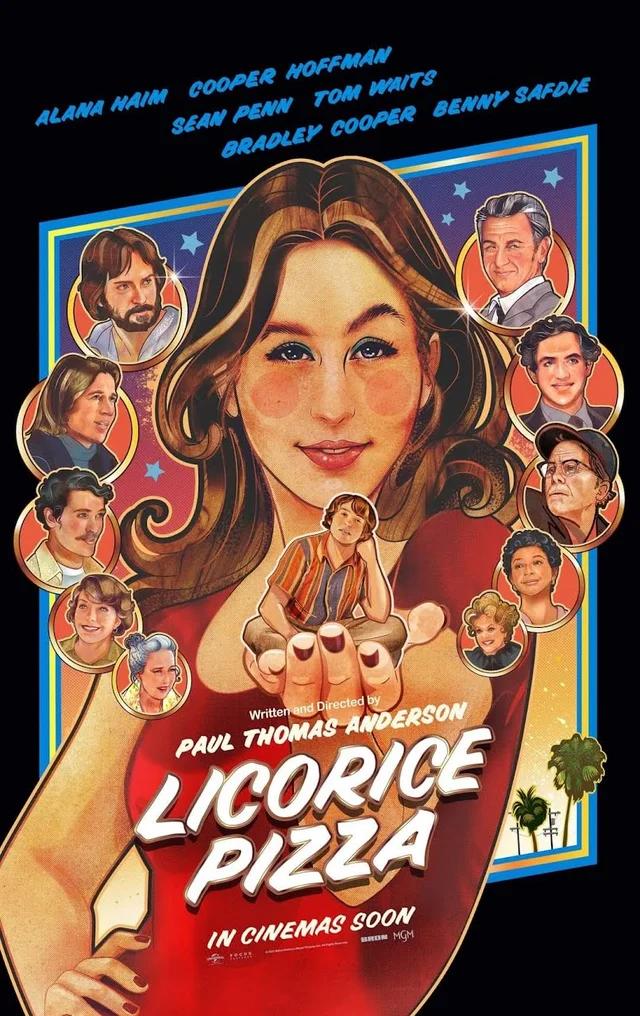
Licorice Pizza – Film Review

Licorice Pizza (2021) - IMDb

Director: Paul Thomas Anderson

Writer: Paul Thomas Anderson

Starring: Alana Haim, Cooper Hoffman, Sean Penn, Tom Waits, Bradley Cooper, Benny Safdie, Mary Elizabeth Ellis

Rating: ★★★½

Paul Thomas Anderson’s later film, Licorice Pizza, is loosely based on Anderson’s friend Gary Goetzman, a former child actor who also took some strange career turns at different points in his life. Taking that Anderson has created a story about a fifteen-year-old, Gary Valentine (Cooper Hoffman), who falls in love with someone ten years older than him, Alana (Alana Haim).

The story feels like a series of shorts that are connected through the two central characters. Gary is a child actor, who is outgrowing that occupation, before moving to owning a waterbed company, then a pinball arcade. Alongside him Alana follows him until she starts to go to auditions and also becomes involved in politics and starts her own path, volunteering at for a campaign office, that at one point feels like it’s going to turn into Taxi Driver. Inside the bigger stories are small moments that feel just as random as the big changes in Gary’s life, at one point he’s arrested on suspicion of murder, and one of the waterbeds they delivers is to producer Jon Peters, who is played by Bradley cooper.

The central characters are incredibly authentic and feel like real people. Both Cooper Hoffman and Alana Haim give excellent performances that are full nuance. It’s hard to believe that this is the first film that either of them has appeared in. Bradley Cooper is also amazing as Jon Peters, who is portrayed as a bizarre and sinister character. He’s brilliant and the segment that he’s in is the highlight of the film. There are also stellar performances from Sean Penn, Tom Waits and Benny Safdie, in the small portions they appear in.

So much happens in the story at different points, and you’re never sure where it’s going next. Because of this at times it does start to feel very aimless and is heading towards tedium. It’s so quick paced that it never gets boring, but it comes close at points. It also feels like there are parts that are missing, where time jumps happen. It’s a little jarring in places. Gary is told by his mother that she can’t take him to New York for the press tour, and he would need a chaperone, and then the next moment Gary is on the plane with Alana. You don’t see him ask her to go, which would have been interesting. It’s worse later in the film, one moment they are discussing how an oil crisis will stop waterbeds from being made, the next moment they are loading up a van and it’s not clear what’s going on until they get to Peter’s house to set up a new bed. It happens in other places as well, and does make you feel out of the loop a little.

The biggest hurdle with the film is the relationship between the two characters. Gary is fifteen and Alana is twenty-five. At first, she makes it very clear that they aren’t dating, but that line is blurred further and further as the film progresses. There are clear boundaries between the characters, which makes it easier to accept, but it’s still something that’s never completely dealt with. Despite the age gap in numbers, in feels very blurry between them. Gary may be fifteen but acts with the confidence of someone a lot older. He’s charming to almost everyone he speaks to and is always trying to find new careers paths in life to make money, while contrastingly Alana is a lot more immature, she’s ten years older but stuck in a dead-end job until Gary offers her something different. Aside from a few short moments in the film, their age doesn’t really matter and they’re not really a couple, even if it does feel that way throughout.

Licorice Pizza is a nostalgia fuelled look at the 1970s, with great sets, costumes and some classic songs. The cast is excellent and while the film does meander at points, it’s elevated by Cooper and Haim who are both beyond excellent. It may not be the most essential film to start the new year with, but it’s has some great moments.  

Thanks for reading! If you liked my review please subscribe to never miss a post:
Posted in film reviews | Tagged , , , , , , , , , , | Leave a comment

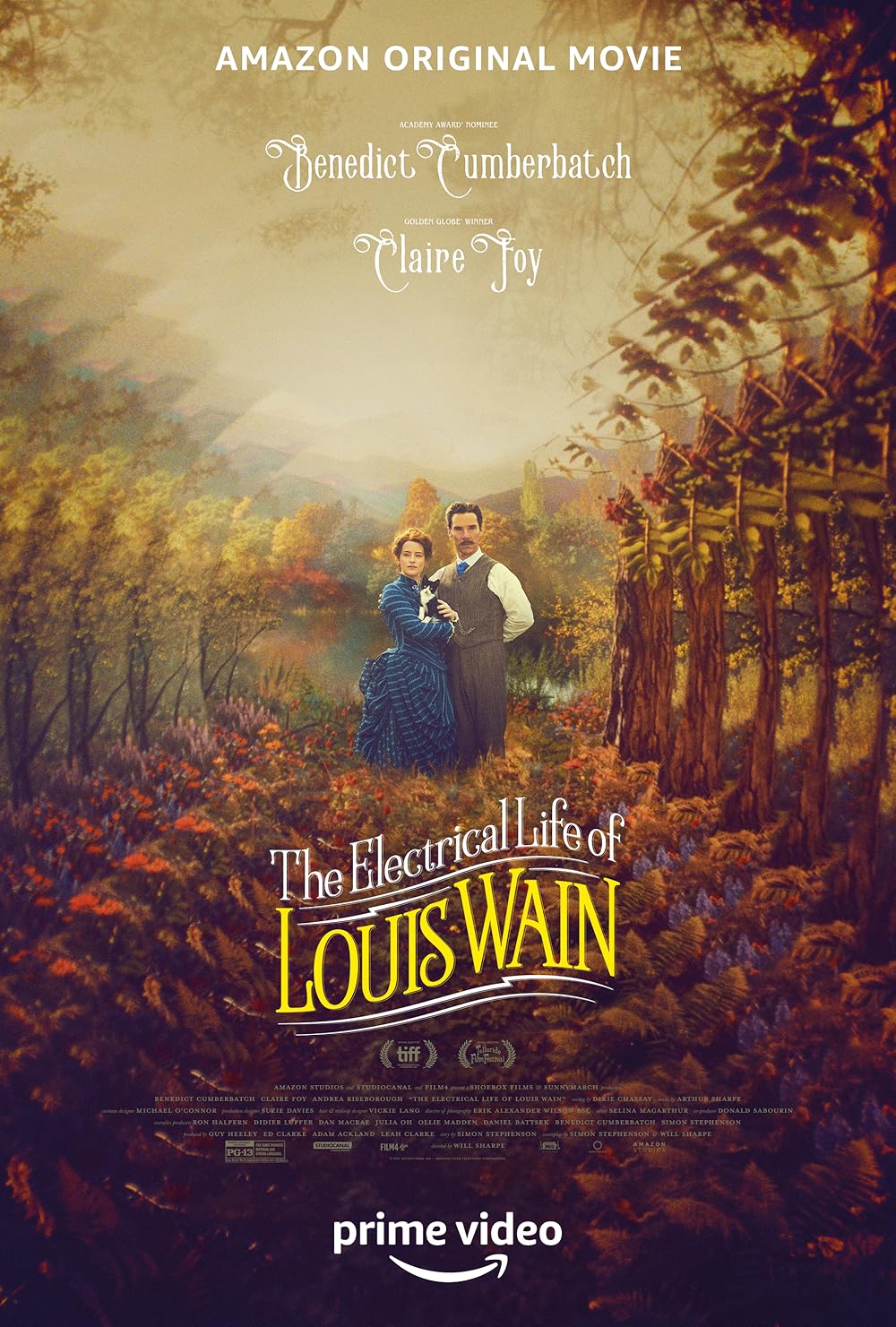
The Electrical Life of Louis Wain – Film Review

The Electrical Life of Louis Wain (2021) - IMDb

Director: Will Sharpe

Writers: Simon Stephenson and Will Sharpe

Starring: Benedict Cumberbatch, Claire Foy, Andrea Riseborough, Toby Jones, Jamie Demetriou, Aimee Lou Wood, Hayley Squires, Stacy Martin, Julian Barratt, Sharon Rooney, and Olivia Colman

Rating: ★★★★★

Before Louis Wain the idea of keeping a cat for a pet was almost unheard of in the UK. The artist Wain and his drawings of cats captured the hearts of the nation. His work was celebrated by many around the UK, and while his work is quirky and whimsical, his life was a lot more tragic, which is what The Electrical Life of Louis Wain is exploring.

To provide for his sisters and widowed mother, Louis Wain (Benedict Cumberbatch) works as an illustrator for The Illustrated London News, drawing animals with speed and accurate detail. He falls in love with his younger sister’s governess, Emily Richardson (Claire Foy), and much to the dismay of the rest of his family, they marry. Their perfect life together is short-lived once they discover that Emily has terminal cancer. Louis struggles with the impending loss of his wife, as well as monetary issues. To keep Emily happy, he draws picture after picture of their pet cat, Peter, and she pushes him to get the pictures published, which leads him to great success. After Emily’s death, he falls completely into his work, creating dozens and dozens of pictures, but without copyrighting them, he doesn’t earn a lot and his money issues persist.

Louis Wain is a strange and quirky person at the beginning of the film, he’s introduced to us sitting on a train after a run in with a bull he was throwing peanuts at, almost instantly afterwards he’s learning boxing and then we learn that he has many lost hobbies and is constantly moving to keep his mind away from the darkness that lies underneath. It’s a tragic story but it’s also filled with love and joy. Wain’s pictures have brought a lot of joy to people’s lives and Wain left the world a slightly happier and better place than when he left it, and that’s all anyone can really hope to achieve.

Wain struggles with severe anxiety and looks at the world through a different lens that most people. He sees something that he refers to as electricity, this unseen force that can bring good and happiness or extreme sorrow. He believes that electricity can cure all illnesses and when he first sets eyes on a spot with Emily that would be come special, he describes it as electricity. It’s almost as if that’s where his strange and wonderful cat drawings are coming from, an ether in the universe that he can tap into. His drawings often involved anthropomorphic cats performing mundane tasks, while others were much trippier and more bizarre, while keeping the cat motif of his work. There’s a beauty in his work that’s filled with simple joy and pleasures, that hides his grief and pain at the loss of Emily.

Benedict Cumberbatch gives the best performance of his career as the tortured artist. He’s always been great as historical figures but is in another league with this one. He perfectly captures the pain, anxiety, and quirkiness of Louis Wain. It’s not just the strange and wonderful that’s so great about Cumberbatch’s performance, it’s the genuine sense of loss and grief you get from him. His pain attaches itself to you, until you’re in tears as well. There’s a scene at a boxing match, where he is describing to his friend how he imagines Emily will always be there, so she will be. That electricity can take him back to the past and is absolutely heart-breaking. The love between Louis and Emily feels incredibly authentic, and you feel that same grief.

The visuals are breathtakingly beautiful. It feels like director Will Sharpe has brought a picture-book to life, with uncanny style to everything that feels like Wain’s pictures. It’s gorgeous to watch and accompanying that is a stunning and often otherworldly feeling score from Arthur Sharpe, that’s memorable from almost the first second that you hear it.

The Electrical Life of Louis Wain is an impeccably made film. The direction is wonderful, and Cumberbatch’s performance is career defining. It’s a joyous film that is also full of dark moments and a warm sense of humour. Its an honour to the artist, and his life, as well as a love-letter to cats at the same time.

Thanks for reading! If you liked my review, please subscribe to never miss a post:

Posted in film reviews | Tagged , , , , , , , , , , | Leave a comment

Cobra Kai: Season 4 – Review

Cobra Kai - Rotten Tomatoes

Starring: Ralph Macchio, William Zabka, Courtney Henggeler, Xolo Maridueña, Tanner Buchanan, Mary Mouser, Jacob Bertrand, Gianni DeCenzo, Peyton List, Vanessa Rubio, Dallas Dupree Young, Thomas Ian Griffith, and Martin Kove

Rating: ★★★★

Cobra Kai has consistently been one of the most entertaining and exciting shows in the last few years. It may be deeply rooted in nostalgia for the 1980s films, but the show still manages to bring enough new ideas to the table to keep it feeling fresh and vital. The fourth season is the first that was produced since changing to Netflix from YouTube. The third season, which was produced for YouTube but aired on Netflix, was released on January 1st 2021, and bringing it full circle, the forth season aired on December 31st 2021. The show is still one of the most entertaining shows around and hasn’t lost any of it charm since moving to the streaming giant.

Season four startsexactly where season three left off with Johnny (William Zabka) and Daniel (Ralph Macchio) joining forces to defeat Cobra Kai at the next All Valley Karate Tournament. Sensei Kreese (Martin Kove) seeks out his own help, with old army buddy Terry Silver (Thomas Ian Griffith) who was the main antagonist of The Karate Kid III. The rival dojos prepare for the tournament while also trying to avoid spats throughout the year. Tensions are riding high, and the alliance between Johnny and Daniel starts to see cracks forming.

Just as season three felt like a follow-up to The Karate Kid II, with the recurring characters and a trip to Okinawa, season four is the follow-up to The Karate Kid III. It marks the return of Terry Silver, the borderline psycho villain of the third film. He’s just as menacing here as he was then and works well with Kreese as the antagonists of this season. One of the best moments is Kreese and Silver discussing what happened in the past and acknowledging how over-the-top and ridiculous the events of the third film were. A grown man mentally torturing a teenager, and yet history is starting to repeat itself.

The fourth season is just as ridiculous with the adults using the teenagers to essentially fight their decades old rivalry, even if they don’t believe in it completely themselves. Kreese, Johnny and Daniel have always thought their way is the only way and seeing the younger characters reject their mentor’s ideas and start to find their own path is really entertaining. Just as in previous seasons, there are plenty of twists and turns. Each episode ends on a beat that makes you want to watch the next one straight away and that doesn’t stop right up to the final episode. Let’s hope the wait for season five isn’t that long.

Cobra Kai is a unique show in that it can be extremely funny one moment, deeply moving the next, and then have you on the edge of your seat as characters battle it out on screen. It’s completely over-the-top silliness and yet still manages to excel at whatever tone it’s striving for with ease. After all this time we’ve spent with these characters, we all deeply care about them and seeing them switch alliances, struggle with their own insecurities and come out on top in battle is beyond captivating at this point. It’s pure adrenaline and excitement.

With The Karate Kid, there was the good guy, Daniel, and the bad guy, Johnny. There was very little grey area, and it was clear who you should be rooting for. Right from season one, Cobra Kai has managed to blend the good and the evil into very human characters. You sometimes don’t know who you’re rooting for and everyone watching will have their own favourite characters. The show works perfectly in this regard, and it keeps it up again throughout season 4. The final two episodes showing the tournament is tense, because you don’t know who should win, and it’s anyone’s fight. Even with Kreese and Silver being the clear villains, their students are at points conflicted with their teachings, and their internal conflict is what makes the show so entertaining to watch.

Cobra Kai - Rotten Tomatoes


The characters are all still excellent, with none of them faltering at all. Cobra Kai has a large cast and they’re all given their chance to shine throughout the ten episodes. The rivalry between Daniel and Johnny is still entertaining, the way Daniel struggles with the modern world is just as funny as ever, and the next generation finding their own path and almost rejecting those of their elders is great. Martin Kove shows that he can still be just as scary, if not more, than in the original film with one chilling scene in particular where he confronts Silver. Xolo Maridueña continues to show that he’s the heart and soul of the series and his bond with Jonny is excellent.

There’s also enough room for some cameos from legacy characters that feel completely natural. There’s nothing quite as close to Elizabeth Shue returning for a couple of episodes of season three, but it’s still a treat whenever an older character reappears. On top of that the new addition of Dallas Dupree Young to the cast as Kenny Payne is great. Payne is a geeky teenager who’s bullied relentlessly until he joins Cobra Kai and starts to defend himself.

Through melodrama that could rival a soap opera at points, exciting and thrilling action and some never-ending rivalries, Cobra Kai season four manages to keep the fight going, with pure entertainment throughout every episode. The cliff-hanger ending proves the fight is far from over and that’s the best way to start 2022.

Thanks for reading my review! If you liked it, please subscribe to never miss a post:

Posted in film reviews | Tagged , , , , , , , , , , | 2 Comments

Rashomon – Film Review

Rashomon (1950) - IMDb

Director: Akira Kurosawa

Writers: Akira Kurosawa and Shinobu Hashimoto

Starring: Toshiro Mifune, Machiko Kyō, Masayuki Mori, Takashi Shimura, Minoru Chiaki

Rating: ★★★★½

Akira Kurosawa’s Rashomon is a good contender for one of the most important films ever made. It was one of the first films that presented events from different and conflicting perspectives. It was so successful in doing this that the title has become its own term, The Rashomon Effect, where an event is seen differently by the individuals present. Strangely, or maybe even fittingly, when the film was first released in Japan it didn’t receive the acclaim it has in the years since. When the film was chosen to be shown at Venice Film Festival, the Japanese government at the time were opposed to the idea. Western audiences were incredibly impressed with Rashomon upon its worldwide release, and it has since gained a status as one of the best films in the world.

Rashomon tells the story of a murdered samurai, and the rape of his wife. The story is told from four different perspectives, a local bandit who claims to have committed the murder, the samurai’s wife, the samurai himself (through a medium), and a woodcutter who was passing through the woods. All four versions of the events conflict with each other completely, and by the end of the film none of the versions are pinpointed as the actual truth, instead it’s left up to us as the audience to make our minds up. Kurosawa use of unreliable narrators, flashbacks, and embedded narratives, recreates how little we can trust our memories and how people do see the same event completely differently. You can never truly trust what someone else said happened, and even if you were there you can’t completely trust your own mind. All of the characters have their own reasons for twisting the truth, even if they don’t realise, they are doing it. The first line of dialogue from the woodcutter at the start of the film is ‘I don’t understand’, which is repeated over and over in the opening scene. It pretty much sums up the film.

Adding to the layer of unreliability is the way the story is framed. The woodcutter and a priest are sitting at Rashomon gate, discussing the trial they had just witnessed trying to get to the bottom of the murder. A man who is walking, shelters from the rain, and they tell him the story, so you witness the murder, not through the witnesses, by from third-hand information. It’s used to great effect and really makes you think about the middle-ground where the truth must lay, but at the same time the story isn’t really about what is true, it’s about human nature and how we embellish our memories and present ourselves in different ways.

There’s also something very striking about the way Kurosawa directed the film. The flashback to the woods were shot outside making it feel incredibly authentic, contrasting with the almost stage-like set up of Rashomon gate and the courtyard where the trial takes place. Those are the only 3 settings of the film, and the later two feel like something from a play, while the woods are more alive and real. It blends reality and fabrication in the same way the conflicting stories does.

There are also some really long and distinctive shots that are mesmerising to watch. The first flashback, with the woodcutter discovering the body starts with him wandering through the woods with his axe, it feels almost magical, like something out of a fairy tale, especially since it’s combined with a score that would almost feel at home in an early Disney film. Also, in one version of the events, the samurai and the bandit fight each other, which is one of the greatest moments in the film. It’s incredibly tense and really captures the fear both men have. You can hear every pant of breath, the shakiness of the bandit’s arm and the desperation in the samurai’s face as he realises there’s no escape. The acting is extraordinary, and it really hits you in the gut, even though you know exactly what is going to happen, even if you don’t want it to.

There are a lot of films that people claim to be one of the best ever made, and they are almost always disappointing when you get around to them. Rashomon lives up to its reputation. It’s a film that will stay with you for a long time after the credits role and a film that’s inspiration is still seen today. It would be hard to imagine that the very recent, The Last Duel, would exist if Kurosawa’s masterpiece didn’t come first.

Thanks for reading! If you liked this review, please subscribe to never miss a post:

Posted in film reviews | Tagged , , , , , , , , , , | Leave a comment

The Lost Daughter – Film Review

The Lost Daughter (2021) - IMDb

Director: Maggie Gyllenhaal

Writer: Maggie Gyllenhaal

Starring: Olivia Colman Jessie Buckley, Dakota Johnson, Peter Sarsgaard, Ed Harris, Paul Mescal, Dagmara Domińczyk, Oliver Jackson-Cohen, Jack Farthing

Rating: ★★★★

Maggie Gyllenhaal’s directorial debut, The Lost Daughter, which she also wrote the screenplay for, is based on the novel of the same name from Elena Ferrante. It’s a story about a woman who’s looking back on her life and is haunted by her past, and choices she made.  

While on holiday alone in Greece Leda Caruso (Olivia Colman) starts to get tangled up with another family who are on holiday at the same time. Her quiet time on the beach is interrupted as the loud and large family arrive, and she can’t help watching them, which reminds her of her own past and family. One day, the family’s young daughter goes missing and Leda is the one to find her and bring her back. At the same time the girl’s doll goes missing, which Leda also finds, but isn’t compelled to give it back. The doll reminds her of one she had as a child, so she takes it back to her apartment and keeps it a secret.

The Lost Daughter is an incredibly intimate film, there are lots of close-up shots and the camera is often shaking, as if we are sitting with Leda as she’s on holiday. It can be a little jarring at times, especially in the beginning, but once you’ve settled in, it’s gripping, and you feel like you’re part of the story. Gyllenhaal has perfectly captured the sense of regret and depression that Leda is feeling as her past is unravelling around her, and it’s at times uncomfortable to watch. Because of how close the camera is, you feel almost implicit with the stealing of the doll, willing Leda to give it back to the crying child, while at the same time understanding why she’s keeping hold of it.

Olivia Colman is phenomena as Leda; you can feel every emotion through her facial expressions. The isolation she feels, the anger, the fear and regret. She carries it all and it completely captivating. You can tell what she’s thinking as she sits on the beach watching the family go about their day, each movement telling another story. Jessie Buckley is also wonderful as the younger Leda, capturing the essence of Colman’s portrayal in the present.

Leda’s holiday is infused with a haunting sense of isolation. She’s travelling alone, the place seems empty and there’s a detachment from everyone else for the most part. Leda seems to want to distance herself from the staff, their interactions often leading to awkward reactions, when she does start to get friendly with people, it leads to her getting tangled up in events she doesn’t really want to be involved with and is kind of punished for it throughout. The first time Leda talks to her daughter over the phone, she’s excited to talk about her holiday, but the voice on the other end of the line doesn’t seem to be listening, and the conversation is cut short.

The central theme is abandonment and loss, and that’s what Leda is struggling with and causing her isolation. She feels like she abandoned her children when she was younger, and their relationship has struggled since then. There’s the child who is lost on the beach, who in turn loses her doll. It’s a depressing story that can be hard to watch at points.

The Lost Daughter is an honest and powerful portrayal of motherhood. It’s a slow-paced film that lets you sit with Leda as her past is unfolded. Gyllenhaal’s debut as a director is a poignant and emotional film and one that will no doubt receive a lot of nominations, adding to those it has already collected, during awards season.

Thanks for reading! If you liked my review, please subscribe to never miss a post:

Posted in film reviews | Tagged , , , , , , , , , , | Leave a comment